
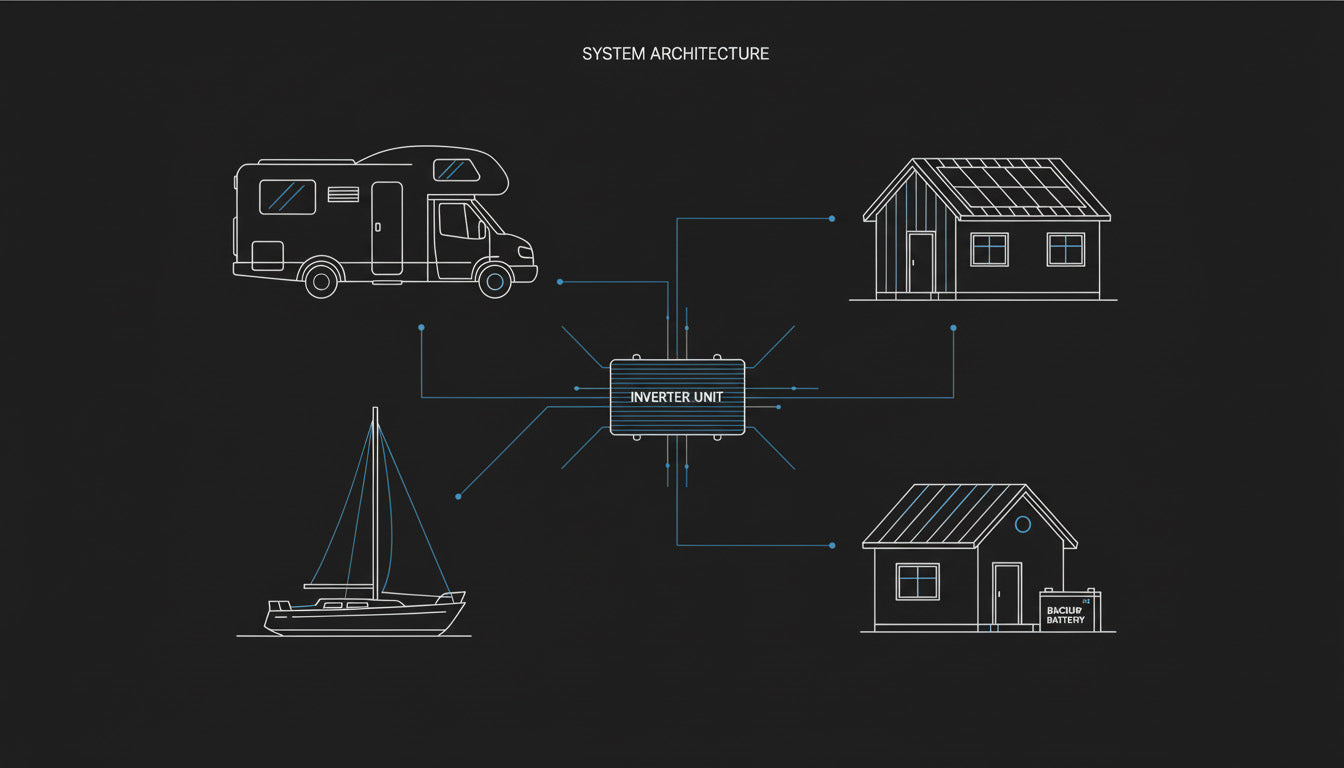
Where EDECOA Inverters Are Commonly Used
EDECOA power systems support a wide range of energy applications, including:
- Recreational vehicle power systems
- Solar off-grid installations
- Marine and mobile systems
- Residential emergency backup
Each application requires a different balance of power capacity, waveform quality, monitoring capability, and installation design.

RV & Camper Power Systems
Designed for mobile living environments, RV power systems must deliver stable AC output from battery sources while handling appliances such as microwaves, refrigerators, lighting, and entertainment systems.
Key considerations:
- 12V / 24V battery systems
- Compact installation space
- Efficient power conversion
- Surge capability for compressors

Solar & Off-Grid Energy Systems
Off-grid solar systems require integrated energy management between solar panels, batteries, and AC loads.
System priorities include:
- Stable pure sine wave output
- Efficient battery charging
- Runtime optimization
- Monitoring and system diagnostics

Marine & Mobile Installations
Marine environments demand vibration tolerance, compact design, and stable output under fluctuating battery conditions.
Important factors:
- Corrosion-resistant housing
- Efficient DC current handling
- Protection systems
- Monitoring visibility

Emergency Backup Power
Backup systems must provide reliable AC supply during grid outages, supporting essential circuits and household appliances.
Design priorities:
- Fast response
- Surge stability
- Battery protection
- Safe installation

Choosing the Right System
Selecting the appropriate inverter solution depends on:
- Total continuous load
- Surge requirements
- Battery voltage
- Runtime expectations
- Monitoring needs
For technical guidance, visit:
→ Inverter Sizing Guide
→ Battery and Inverter Matching Guide
→ Surge Power Requirements
From Standalone Inverters to Integrated Energy Systems
EDECOA designs power solutions that scale from standalone inverters to integrated hybrid energy systems.
As energy storage and monitoring technologies evolve, application-specific system design becomes increasingly important.
Understanding the application is the first step toward building a reliable energy system.